
2025 marked the seventh year for GAIA as a non-profit organisation. This report outlines the past year and our outlook for the future.
During the year, the GAIA board consisted of Jakob Andersson (chair), Josefin Scott (treasurer), Amanda Bowald (secretary), and Danila Petrelli. Daniel Sääf was the auditor.
One can join GAIA as a member by registering through our webpage and paying the membership fee. Between the last annual meeting (2024-11-19) and the date of this report, 67 people have joined as members.
Our social media audience has continued to grow. On LinkedIn—our primary marketing channel—we now have 3,372 followers, a 41% increase from last year. Similarly, we have grown to 1,848 YouTube subscribers, up 13% from the previous year. We recorded 17,400 views, amounting to 1,200 hours watched during the year. Meetup.com, with 1,887 members, serves primarily as a platform to facilitate our smaller events.
Last year, we rebuilt our website using Webflow. We have continued to improve the site this year, and the new platform has performed well. We faced some limitations in visualising our conference programme, but we plan to resolve these before the 2026 conference. The new platform is user-friendly and provides a more stable and scalable foundation than our previous systems.
For the 2026 GAIA Conference, we introduced a new ticketing system: Checkin. Although the system ultimately functioned adequately, the experience was marred by various issues. Checkin is a Norwegian platform, and we were among its first, if not the first, customers in Sweden. The launch was hampered by significant delays in card and Swish payments, leading to time-consuming workarounds involving invoices. Translation issues and bugs also affected the user experience. The system is a good fit for us, but this year's experience was very tiring for the team.
As the conference has expanded, so has the administrative workload, particularly ticket sales, attendee management, and accounting. Therefore, the board decided to outsource this work to Meetx, a subsidiary of Svenska Mässan, for the 2026 conference. We will handle our conference finances through Meetx, which means we will both charge and deduct VAT. The board hopes that this arrangement will allow the conference committee to concentrate on the creative aspects of developing the conference. The board will review the setup after the 2026 GAIA Conference. We do not believe that continued reliance on volunteer efforts will be sustainable if the conference continues to grow, as we anticipate it will, so alternative solutions, such as hiring staff, must be considered if Meetx does not meet expectations. Moving to Meetx also means switching our ticketing system to Trippus, their platform.
As the conference has expanded, so has the administrative workload, particularly ticket sales, attendee management, and accounting. Therefore, the board decided to outsource this work to Meetx, a subsidiary of Svenska Mässan, for the 2026 conference. We will handle our conference finances through Meetx, which means we will both charge and deduct VAT. The board hopes that this arrangement will allow the conference committee to concentrate on the creative aspects of developing the conference. The board will review the setup after the 2026 GAIA Conference. We do not believe that continued reliance on volunteer efforts will be sustainable if the conference continues to grow, as we anticipate it will, so alternative solutions, such as hiring staff, must be considered if Meetx does not meet expectations. Moving to Meetx also means switching our ticketing system to Trippus, their platform.
On April 10–11, we hosted our annual main event. This year, we introduced three key changes: expanding and relocating our workshop concept to Svenska Mässan, increasing conference capacity by 250 tickets, and launching late-bird pricing.
The conference, held on Friday, April 11, reused the spaces introduced the previous year, featuring keynotes and one track in the Congress Hall and one track in H1+H2. The latter room expanded seating for the second track by merging two rooms. Once again, we sold out despite significantly increasing the number of seats. The Congress Hall accommodates 1,500 attendees, and H1+H2 is at capacity. We had 25 speakers and 21 talks. One speaker cancelled at the last minute, but we managed to provide a backup for that slot. All recordings are available on our YouTube channel.
This year, we made notable improvements to the conference decor, creating a better atmosphere. We added large block letters, floral decorations on stages, a photo wall, extra digital screens, and other adornments throughout the venue. Many of these decorations are reusable, and we have secured a storage room at Shurgard for our equipment.
On Thursday, 10 April, we hosted six workshops in rooms R4 and R5+R6. These rooms seated 30 and 36 people respectively, with most sessions lasting two hours, and one extending to three hours. The workshops covered topics from practical coding exercises to business and compliance. A partner company hosted each workshop. Initially, ticket sales were sluggish because the concept had not fully established itself, and we could not sell tickets for individual workshops until the content was finalised. Ultimately, four workshops sold out, while the remaining two nearly did.
We maintained our early-bird, regular, and student ticket prices and introduced a late-bird rate—50% above the regular price—for the final month to encourage early purchases and support event planning. Two-thirds of general admission tickets were sold before the late-bird price was introduced. This was an improvement over the 54% from the previous year, though the impact was less than anticipated. The profit margin on late-bird tickets, however, allowed us to be more flexible with our food ordering.
We sold five gold, eight silver, three bronze, and four startup partnership packages, keeping the previous pricing. This resulted in a 15% increase in partnership revenue, but more importantly, the partnerships were finalised earlier, boosting our confidence to invest in the event. We also secured six complimentary partnerships, including AI Sweden and Furhat Robotics, both of which exhibited at the conference. We did not manage to sell the platinum package, the barista booth, or the after-conference event. In total, partnership revenue reached 690,000 SEK. These partnerships nearly cover all fixed conference costs. Our partners were pleased with the event, although some staff noted the noise levels in the exhibition area.
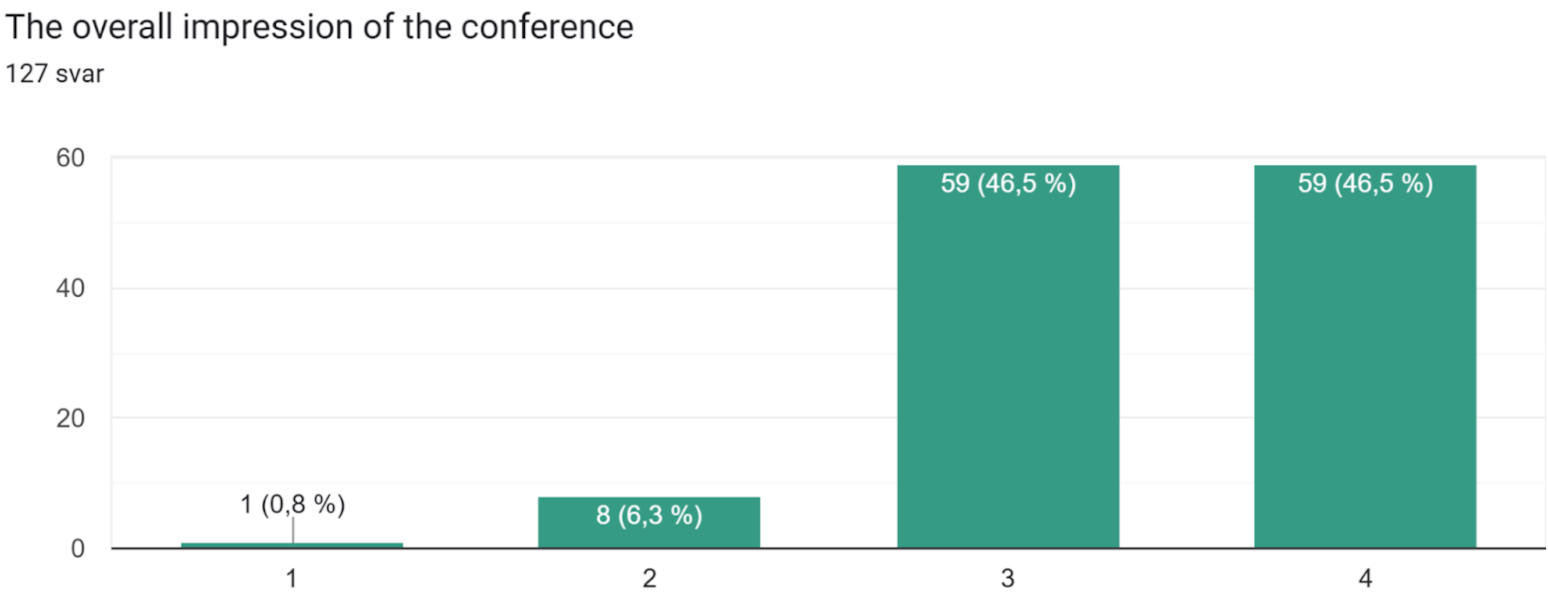
Our attendee survey indicates that our guests remain pleased with the conference, with 93% giving favourable responses on a 1–4 scale. Additionally, 87% feel we provide valuable opportunities for networking and learning. These results mirror those of the previous year. Feedback on the sessions’ difficulty is becoming more diverse—some attendees are seeking deeper, more technical content, while others feel the sessions are somewhat too challenging. This variation is expected as our audience grows, comprising a strong core of machine learning, data science, and data engineering practitioners, alongside the increasing presence of users and stakeholders.
The conference achieved a significant profit, mainly driven by strong ticket sales and a healthy margin on late-bird tickets. Our partnerships allow us to subsidise student tickets.
The conference significantly impacts our finances. We generated substantial profit, strengthening our financial buffers. Revenue increased by 36% compared to 2024, mainly driven by ticket sales from 250 more attendees, higher ticket prices, and additional partnership income. We continue to subsidise student tickets and encourage regular ticket buyers to purchase early through early-bird and late-bird pricing.
Our buffers remain around our fixed costs, approximately 50% of annual expenses. This buffer offers stability to our finances and confidence to invest in the event before seeing strong traction in ticket and partnership sales. This is especially important given the lead time required for preparations and the ongoing trend of late ticket purchases despite increased incentives to buy early. The board maintains a target buffer equal to the conference's fixed costs; for 2026, we estimate this to be 1 MSEK.
The profit was 179,482.81 SEK, representing a 10.5% margin. Our buffer now stands at about 0.7 MSEK. GAIA remains healthy for the future.
We continue growing our event while maintaining favourable reviews. Over the last two years, our audience has increased by 70%. This is both exciting and challenging. The audience is becoming more diverse, and logistics management is becoming more complex. For 2026, we will expand with a third track, allowing us to develop and include more specialised content. Our goal is to reach 1,200 attendees next year, nearing the 1,500-capacity limit of the Congress Hall.
The number of late-bird tickets suggests low price sensitivity. Most tickets are purchased by employers, with students being a notable exception, and we remain considerably more affordable than similar events. The board has decided to raise prices for 2026 and to make the late-buyer premium more substantial, encouraging earlier sales.
Our meetup activities continue to decline compared to the conference. While we are happy to host events, we are not actively pursuing meetups.
Our conference is improving and growing rapidly. The demand on the conference committee is also increasing, and we will invest in support from Meetx. Further growth may necessitate hiring to relieve our volunteers.
The AI community in Gothenburg is strong, and we aim to expand our audience and influence, positioning ourselves as the leading event for machine learning, data science, and data engineering practitioners in the Nordics.
Gothenburg, 2025-11-23
Jakob Andersson
Chair
Josefin Scott
Treasurer
Amanda Bowald
Secretary
Danila Petrelli
Board Member


