
2023 was the fifth year for GAIA as a non-profit organisation. This report describes the year passed and our outlook for the coming year.
During the year, the GAIA board consisted of Jakob Andersson (chair), Josefin Scott (treasurer), Amanda Nilsson (secretary), Danila Petrelli, Niklas Antončić, and Erika Pauliukevičiūtė. Daniel Sääf was the auditor.
One can join GAIA as a member by registering through our webpage and paying the membership fee. In the period between the last annual meeting (2022-10-26) – when the meeting set the price – until writing this report, 57 people joined as members.
Our audience on social media has continued to grow. On LinkedIn—our primary marketing channel—we now have 1,447 followers, up 62% from last year. Similarly, on YouTube, we have grown to 1,308 subscribers, up 49% compared to last year. We had 25,600 views, corresponding to 1,900 hours watched during the year. Meetup.com is, by now, only a place to facilitate our smaller events.
During the year, we had three smaller events beyond our main event – the 2023 GAIA Conference. We collaborated with Ericsson, Södra, and Recorded Future for the three meetups. They averaged 46 attendees. AI Sweden hosted our event with Södra.
The meetup concept – both the platform and the type of event – is colder than before the pandemic. Few companies reach out about hosting events, and the events we host take a long time to organise. There is also much less interest from the community, with events taking significantly longer to fill. We hoped this would improve this year, but it has not. We suspect the interest shifted towards more niche events, e.g. computer vision rather than machine learning, as the industry and community matured.
As always, the conference was our main event this year. On April 5, 2023, we returned to Svenska Mässan for a full day of machine learning, data science, and data engineering. The event sold out despite us increasing the available tickets to 650. Ultimately, we had a queue of over 60 people who could not attend. Our two tracks saw 27 speakers (21 talks) from 20 companies. The recordings are available on our YouTube channel.
We offered the same five partnership tiers—platinum, gold, silver, bronze, and startup—as previously. We had 18 partners, but unfortunately, no platinum partner this year. All partners except the bronze tier had booths and attended the conference. Our partners were pleased with the event. The financial climate with rising interest rates made companies stricter with their budgets, and some declined a partnership even if they attended the event.
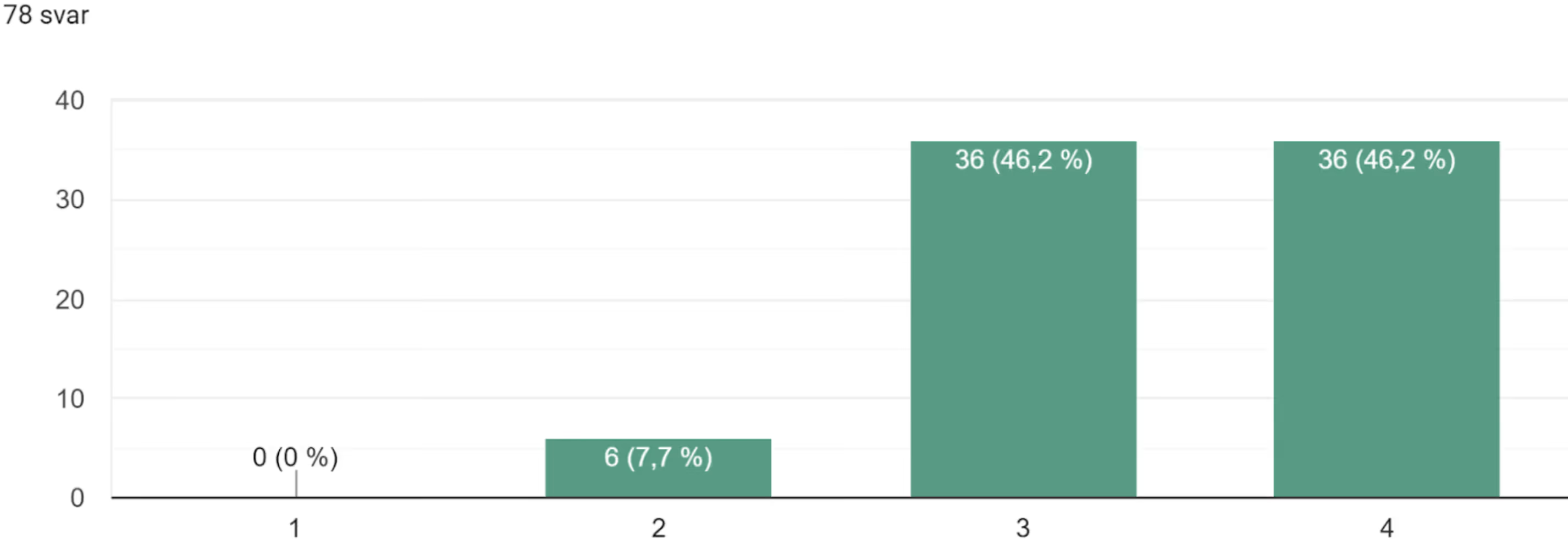
The attendees were pleased with the conference. We had fewer responses to our survey, but 92% of respondents had an overall positive impression of the conference (the scale is 1–4). The participants believe we deliver on our goals of supplying an opportunity for networking and learning while showcasing cool things happening in Gothenburg.
We raised our ticket prices slightly to accommodate the steeper prices charged by Svenska Mässan. 600 SEK (300 SEK for students) per person approximately covers the direct costs of each participant (mainly food and drinks) and is still very affordable. We want our event to be accessible to everyone regardless if they have company sponsorship. However, no-margin ticket prices cause significant risk in our plans as we do not know the costs when determining the prices. We believe there is additional room for increasing our prices, except for students, without compromising the conference's accessibility.
Most revenue comes from our partners and covers all aspects of the conference beyond food and other direct attendee costs. We kept our partnership prices unchanged compared to 2022. The platinum tier costs 100,000 SEK, the gold tier 60,000 SEK, the silver tier 30,000 SEK, the bronze tier 10,000 SEK, and the startup tier 1,000 SEK. We sold three gold, nine silver, four bronze, and two startup packages. Additionally, we gained some sponsorship for our expanded AfterConference from Kognic, covering about half that cost. In total, our partners provided an income of 532,600 SEK. We also offered a free booth for Women in Tech.
The conference made a negative financial result due to significantly increased costs from Svenska Mässan. The conference finances are heavily dependent on our partners. One extra gold partner would have made the event profitable. Many partners decide late, so starting earlier and increasing our efforts to bring in partners should be a priority in the future. Likewise, most tickets sell late, causing a financial risk from the food as food and beverages are our most considerable expense.
We made a loss this year—the first loss for the organisation. The cause was a negative contribution from the conference due to significantly increased costs to Svenska Mässan. This loss shows the importance of a solid buffer in our finances—something we have. The conference finances rely heavily on our partners, and a single extra gold or above partner would have made the conference profitable. Both partnerships and tickets often sell late, causing risk and uncertainty in our finances. Pushing sales earlier and increasing ticket margins would improve our ability to adapt costs to revenue. Still, we aim to keep the conference accessible, so we want to continue offering way cheaper tickets than most similar conferences do.
The loss was −42,359.78 SEK, corresponding to a margin of −5.2%. Our buffer is now around 300,000 SEK. We believe GAIA stands healthy for the future.
We are becoming a conference organisation. Our conference becomes more dominating each year, with a strong brand and increasing number of participants. At the same time, we now have a couple of years with relatively few meetups. Our board believes this change reflects the maturing of the industry and the community. More people work in the field and have established careers in AI. The average age of people in the field is likely significantly higher than when GAIA started. More significant, more professional events over fun evening activities seem like a logical transition. Likewise, it seems logical that people in the community aim to deepen their professional skills rather than learn how to get into the industry. We want to change with the community and continue to aid Gothenburg as an AI region.
In the coming year, we aim to expand the conference further. We have already booked the much larger Congress Hall at Svenska Mässan. It is a scalable venue that can go up to 1,500. There, we get ample room to grow. We will also add ways for partners to market their brand beyond the traditional booth. Our partners are an essential part of the community and also what makes it possible for us to keep accessible ticket prices, so giving them better options should benefit everyone. Due to the significant inflation in Sweden lately, we will be forced to increase our prices. We have always struggled with late sales—we sell the majority of our tickets during the last few weeks before the conference—so we aim to address both issues at the same time by introducing early-bird tickets. Those tickets will be available long before we present any speakers. However, we believe we have a strong enough brand to do that. Those tickets will also be close to our previous pricing and remain very accessible for those who need it, at the requirement of signing up early.
Our quest to make Gothenburg a leading AI region continues. Curiosity and progress orientation will take our community a long way!
Gothenburg, 2023-11-02
Jakob Andersson
Chair
Josefin Scott
Treasurer
Amanda Nilsson
Secretary
Danila Petrelli
Board Member
Niklas Antončić
Board Member
Erika Pauliukevičiūtė
Board Member


